
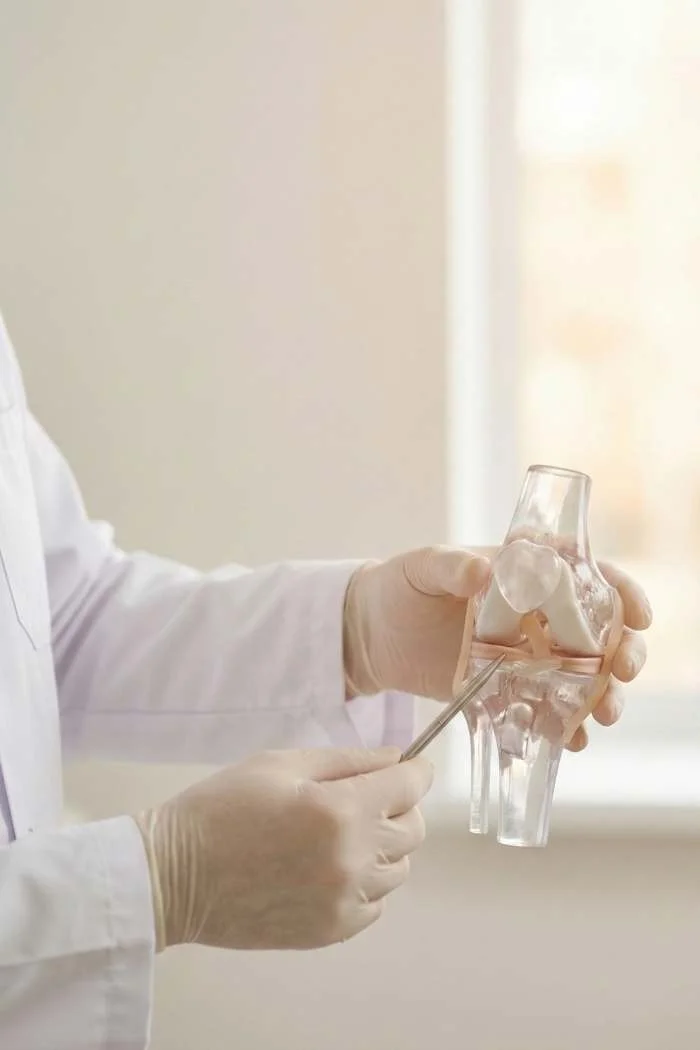
The menisci help distribute load and contribute to stability inside the knee. A tear may follow a twisting injury or deep flexion, but it can also develop gradually as the tissue changes over time.
An MRI finding must be connected with pain, locking, swelling, motion, and the physical examination. Some tears explain the symptoms, while others are incidental findings that do not require surgery.
Symptoms that may occur
A meniscus tear may be associated with:
- Pain along the inner or outer joint line.
- Pain with twisting, squatting, or rising from a chair.
- Swelling after activity.
- Catching, clicking, or locking.
- Difficulty fully straightening or bending the knee.
- A sense of weakness or insecurity with weight-bearing.
These symptoms can also occur with cartilage, ligament, kneecap, or degenerative problems. They cannot confirm a meniscus tear from the webpage alone.
Traumatic and degenerative tears
Traumatic tear
This is more often linked to a twist, change of direction, fall, or sports injury. Age, location, tear pattern, and associated injuries influence whether the tissue may be preserved or repaired.
Degenerative tear
This may develop without one clear event and can coexist with joint wear. MRI findings should be interpreted together with X-rays, symptoms, and response to conservative care.
Not every degenerative tear causes pain, and not every case improves with arthroscopy.
How do we determine whether the meniscus is causing the symptoms?
The evaluation considers:
- How the pain started and which movements provoke it.
- Swelling, locking, or loss of extension.
- Examination of stability, motion, and tender areas.
- X-rays when alignment or joint wear must be assessed.
- MRI when it may change the decision or when a prior study is available.
Imaging does not replace the examination. Bring the full study and report if you already have them.
Non-surgical care, repair, or partial meniscectomy
When non-surgical care may be considered
A non-surgical approach may be reasonable when there is no persistent locking, the knee is stable, and symptoms allow progression with activity modification and rehabilitation.
The plan may address load management, motion, and progressive strengthening. The indication and follow-up should reflect the tear pattern and the overall condition of the knee. See non-surgical options.
Meniscus repair
Repair aims to join and preserve the tissue when the pattern, location, tissue quality, and patient context provide a reasonable chance of healing. Recovery usually requires more protection than a partial meniscectomy.
Partial meniscectomy
This removes only the unstable fragment that cannot be preserved. It does not mean removing the entire meniscus. The decision balances mechanical relief with tissue preservation.
The available technique and final choice are confirmed after evaluation. They cannot be promised from the MRI or the webpage.
Recovery depends on what was done
There is no single timeline. Weight-bearing, crutches, motion, work, and return to sport vary according to:
- Repair versus partial meniscectomy.
- Tear size and location.
- Associated ligament or cartilage injuries.
- Overall joint condition.
- Work and sport demands.
- Progress during rehabilitation.
A repair generally needs more protection to allow healing. A partial meniscectomy may follow a different progression, but it does not guarantee an immediate return.
Risks and treatment limits
Conservative care may not resolve every symptom. Surgery also carries risks and may not eliminate pain when there is joint wear, cartilage damage, or another pain source.
Before deciding, expected benefits, tissue preservation, postoperative restrictions, alternatives, and case-specific risks should be reviewed.
Related pages
- Knee arthroscopy: explains the surgical access and general procedure.
- ACL reconstruction: relevant when instability or an associated ligament injury is present.
- Sports injuries: covers other knee, shoulder, and ankle problems.
Frequently asked questions
Does an MRI showing a tear mean I need surgery?
No. The decision depends on symptoms, examination, tear pattern, joint wear, activity, and response to conservative care.
Is repair always the best option?
Preserving tissue is important, but not every tear can be repaired. Location, quality, stability, and healing potential influence the choice.
Does clicking confirm a meniscus tear?
No. Clicking can have several causes. Persistent locking, localized pain, and swelling provide useful information but still require evaluation.
When can I walk or return to sport?
That depends on whether treatment is non-surgical, repair, or partial meniscectomy, as well as associated injuries and functional progress. The plan is individual.
Where does the evaluation take place?
Consultations take place at Hospital Punta Mita in Corral del Risco. The facility and logistics for any procedure are confirmed after the case is evaluated.