
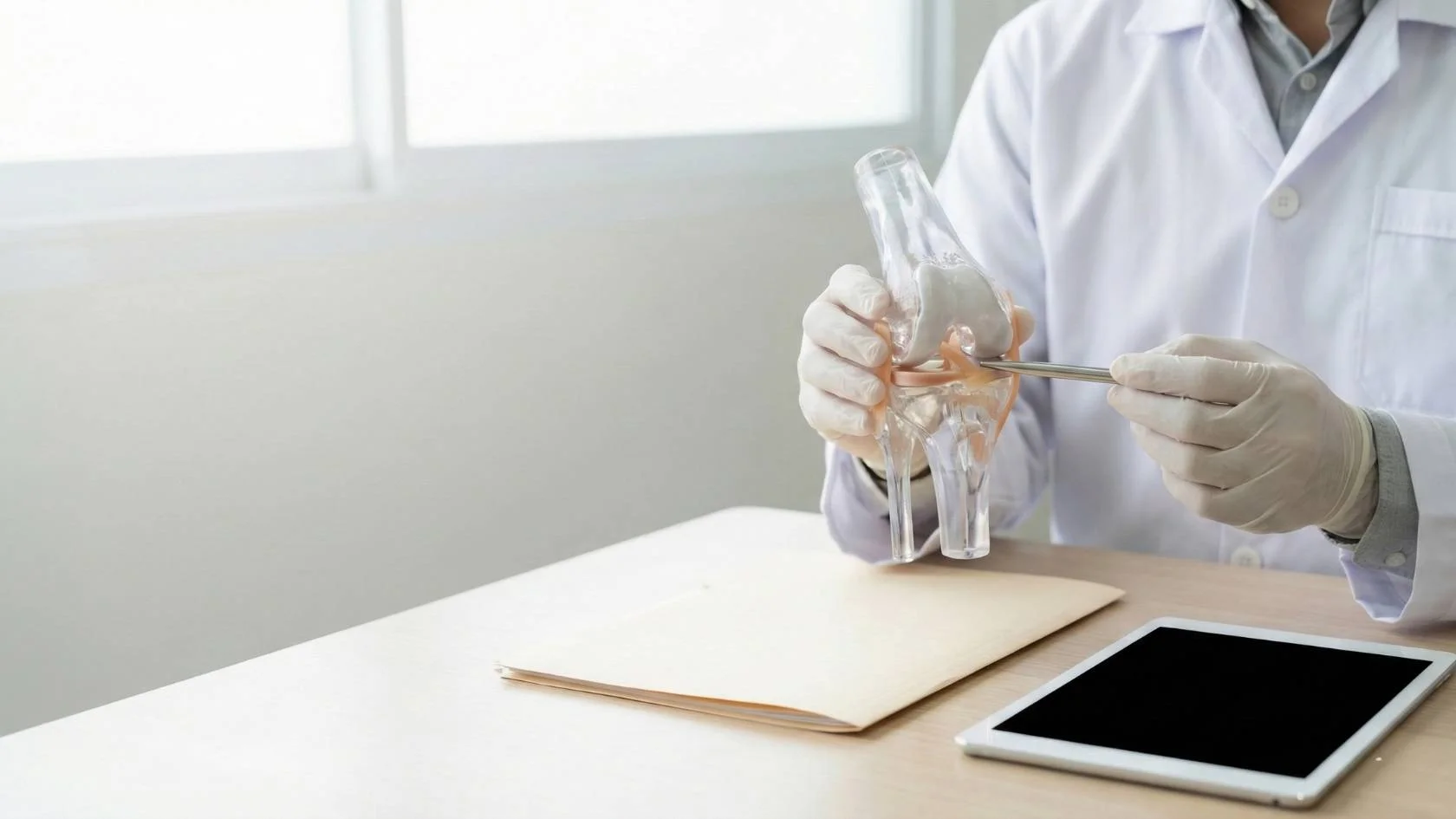
An exercise, training, or recreation-related injury may begin after a twist, fall, impact, or repeated load. Pain alone cannot determine whether the problem involves a ligament, tendon, muscle, meniscus, cartilage, or bone.
The evaluation connects how the injury occurred, which movements are limited, what the examination shows, and whether imaging is actually needed. Consultations take place at Hospital Punta Mita in Corral del Risco, Punta de Mita.
When should you request a prompt evaluation?
Consider an orthopedic evaluation when an injury causes:
- Significant difficulty bearing weight, walking, or using the limb.
- Marked or increasing swelling.
- Giving way, instability, or loss of confidence in the joint.
- Catching, locking, or inability to complete the movement.
- Pain that prevents a return to normal daily activity.
- Symptoms that recur whenever training resumes.
Acute injury and overuse injury
Acute injury
This follows an identifiable event such as a twist, fall, collision, jump, or sudden change of direction. It may affect ligaments, menisci, tendons, muscles, joints, or bones.
Overuse injury
This develops gradually when training load, technique, recovery, and tissue capacity are not balanced. Symptoms often increase with activity and partially improve with rest.
Distinguishing these patterns helps determine whether X-rays, MRI, ultrasound, or another study may be useful. Not every patient needs imaging before the first visit.
Common routes by body area
Knee
Pain after twisting, swelling, locking, or instability may involve the meniscus, ligaments, or cartilage. Review meniscus tear treatment, ACL reconstruction, and knee arthroscopy.
Shoulder
Pain when lifting the arm, weakness, or a sense that the shoulder slips out requires evaluation of tendons, the labrum, the joint, and any history of dislocation. See shoulder arthroscopy.
Ankle and foot
Repeated sprains, pain while running, swelling, or catching can have different causes. An acute injury with inability to bear weight may also require evaluation for a fracture.
Tendons and load
Pain involving the Achilles tendon, patellar tendon, elbow, shoulder, or plantar fascia requires assessment of the involved tissue, load, and provoking movement.
How is a sports injury evaluated?
The visit typically includes:
- Injury mechanism and symptom progression.
- Sport, work, activity level, and functional goals.
- Examination of motion, strength, stability, and painful areas.
- Review of previous imaging, when available.
- Imaging only when it may change the decision.
- Explanation of options, limits, and next steps.
Bring X-rays, MRI images, reports, prescriptions, or prior notes if you already have them. You do not need to repeat studies on your own before the evaluation.
Non-surgical care or surgery
Many injuries can begin with temporary activity modification, rehabilitation, and follow-up. Others require a surgical discussion when there is functional instability, locking, a displaced injury, a relevant rupture, or limited response to non-surgical options.
The decision is not based on MRI alone. Symptoms, examination findings, associated injuries, functional age, activity demands, and recovery goals also matter.
See non-surgical options and the arthroscopy hub to understand different treatment pathways.
Returning to activity is a progression
A return to exercise or sport is not based on one date. Healing, motion, strength, control, load tolerance, and response to progressive training are reviewed. Timing and criteria change according to the injured structure and treatment performed.
No webpage can guarantee a specific athletic outcome. The evaluation helps establish realistic goals and the factors that should be reviewed before increasing demand.
Location and logistics
Consultations take place at Hospital Punta Mita in Corral del Risco. Patients may travel from Puerto Vallarta, Bahia de Banderas, and Riviera Nayarit; these areas are not presented as additional office locations.
When a procedure or surgery is considered, the applicable estimate, facility, preparation, and logistics are confirmed afterward. Insurance coverage depends on the policy, authorization, and current conditions.
Specific Treatments & Conditions
ACL Reconstruction in Punta de Mita
Evaluation of knee instability after an ACL injury to determine rehabilitation, reconstruction, and graft considerations based on activity and goals.
View TreatmentMeniscus Tear Treatment in Punta de Mita
Evaluation of knee pain, locking, or swelling to determine whether a meniscus tear may need rehabilitation, repair, or partial meniscectomy.
View TreatmentFrequently asked questions
Do I need an MRI before the appointment?
Not necessarily. The examination and injury mechanism help determine which study may be useful. Bring any previous imaging, but avoid repeating it without an indication.
Does a popping sound mean I tore a ligament?
No. A pop can occur for different reasons. Rapid swelling, instability, or loss of function increase the need for evaluation but do not confirm a diagnosis by themselves.
Does every sports injury require surgery?
No. Treatment depends on the involved structure, severity, stability, symptoms, activity, and response to conservative care.
Can I keep training while I still have pain?
That depends on the cause, intensity, response to load, and risk of worsening the injury. An evaluation helps determine which activities may continue and which should be modified.
Can WhatsApp tell me what injury I have?
No. WhatsApp is for scheduling and operational information. Diagnosis requires a medical history, examination, and imaging when appropriate.