
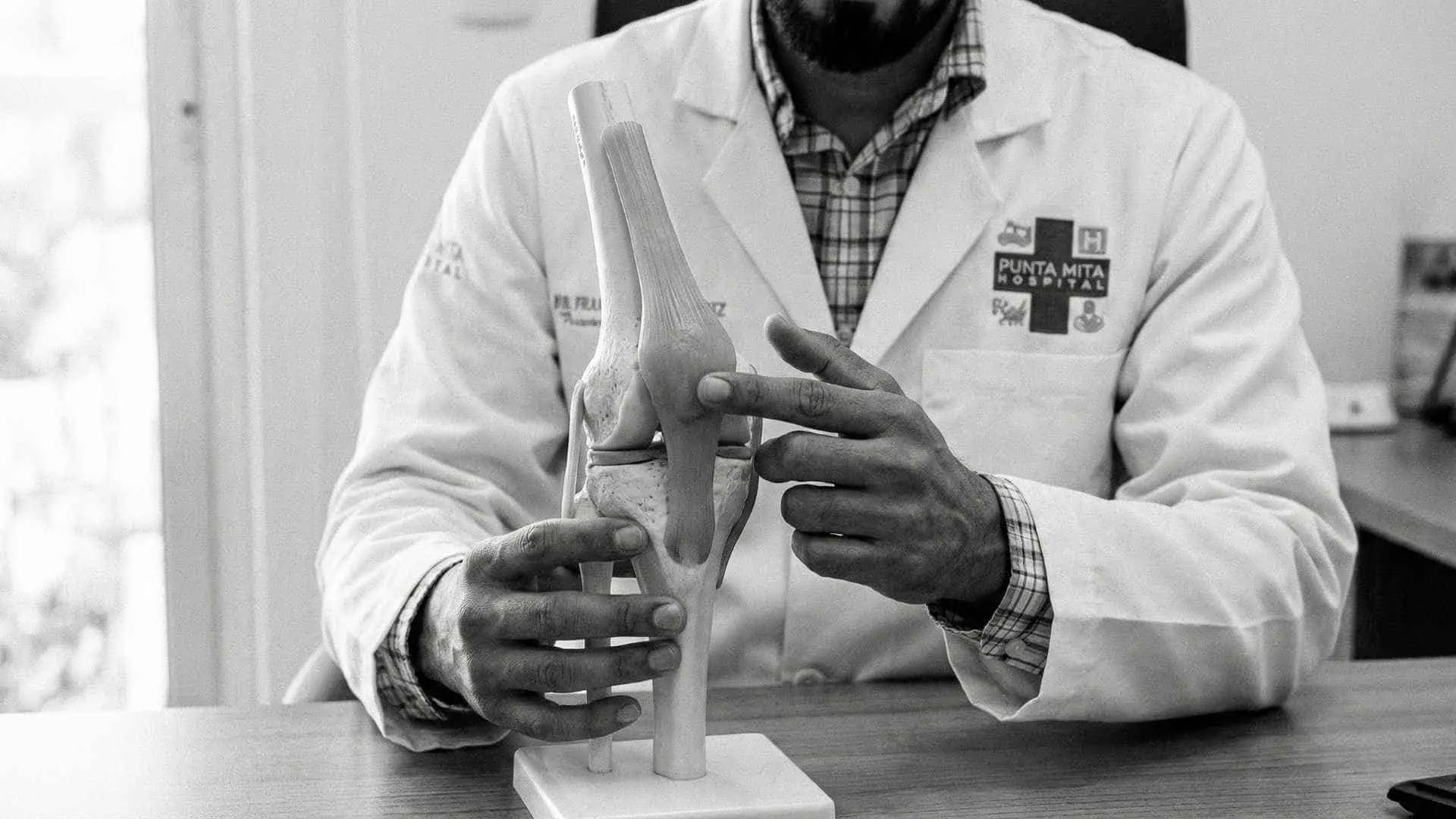
Knee arthroscopy uses a small camera to examine the inside of the joint and perform specific procedures. It may be used for selected meniscus, ligament, cartilage, or loose-body problems, but it is not an automatic solution for every painful knee or for all forms of joint wear.
A procedure should have a defined goal: preserve or repair tissue, restore stability, remove a fragment that blocks motion, or treat a localized injury that matches the symptoms.
Symptoms that warrant an evaluation
Consider an assessment when you have:
- True locking or difficulty fully straightening or bending the knee.
- A feeling that the knee gives way during turns.
- Recurrent swelling after activity or injury.
- Localized pain that persists despite an appropriate conservative plan.
- Painful catching combined with loss of function.
- A sports injury involving a possible meniscus or ligament tear.
- MRI findings that need to be correlated with your symptoms.
Examination, X-rays, and MRI
MRI can show soft-tissue findings, but it must be interpreted together with the examination. A meniscus tear seen on imaging may not be the main source of pain, especially when joint wear is also present.
The evaluation may review:
- Exact pain location and injury mechanism.
- Motion and the presence of true locking.
- Ligament stability.
- Strength and lower-limb control.
- X-rays for alignment and arthritis.
- MRI or CT when those studies add useful information.
You do not need to arrive with an MRI. Bring any prior images and reports you already have.
Problems that may be treated arthroscopically
Meniscus injuries
Treatment may focus on repair or selective removal depending on the tear. Review meniscus tear treatment.
Ligament injuries
Arthroscopy is part of reconstructive procedures such as ACL surgery. Review ACL reconstruction.
Cartilage and focal defects
The likely benefit depends on defect size and location, underlying bone, alignment, and the degree of overall joint wear.
Loose bodies
Bone or cartilage fragments can cause locking or mechanical pain and may be removed in selected cases.
What a simple arthroscopy usually cannot fix
A “cleanup” does not reliably correct advanced, widespread knee arthritis. When cartilage loss is extensive, the discussion may include rehabilitation, symptom management, or joint replacement, depending on the case.
Arthroscopy may also be the wrong option when pain mainly comes from the hip, spine, muscles, or tendons around the knee.
Cleanup, repair, and reconstruction
Cleanup or selective removal
Removes unstable tissue or loose bodies. It usually needs less protection than a repair but does not guarantee immediate recovery.
Repair
Preserves and secures tissue such as a meniscus. Healing may require restrictions on weight-bearing or motion.
Reconstruction
Replaces a structure that cannot be repaired, such as some ligaments. Rehabilitation is longer and return follows functional criteria.
The access does not predict timing
The word “arthroscopy” alone cannot predict crutch use, time away from work, or a sports return date.
Recovery and return to activity
Recovery depends on the exact procedure, associated injuries, cartilage condition, and individual progress. Before surgery, the plan should clarify:
- How much weight can be placed on the leg and whether a brace or crutches are needed.
- When motion and rehabilitation begin.
- Which work tasks can be performed safely.
- When driving may be reasonable.
- Which tests are required before running, pivoting, or returning to sports.
Return to activity should not be based only on elapsed weeks. Strength, motion, stability, and movement control also matter.
Risks and preparation
Potential risks include infection, blood clots, stiffness, bleeding, tissue or nerve injury, persistent pain, and the need for additional treatment.
Bring prior X-rays or MRI, medical reports, a medication list, and information about treatments already attempted. The confirmed consultation location is Hospital Punta Mita.
Frequently asked questions
Does every meniscus tear require arthroscopy?
No. The decision depends on the tear pattern, mechanical symptoms, functional age, activity level, arthritis, and response to non-surgical care.
Will I be able to walk after knee arthroscopy?
It depends on whether the procedure involves removal, repair, reconstruction, or cartilage treatment. Weight-bearing instructions are procedure-specific.
When can I drive?
There is no universal date. The operated leg, pain, strength, motion, medication use, and ability to react safely must all be considered.
Does arthroscopy prevent a future knee replacement?
It cannot be guaranteed. Arthroscopy addresses a specific problem; the progression of arthritis depends on multiple factors.