
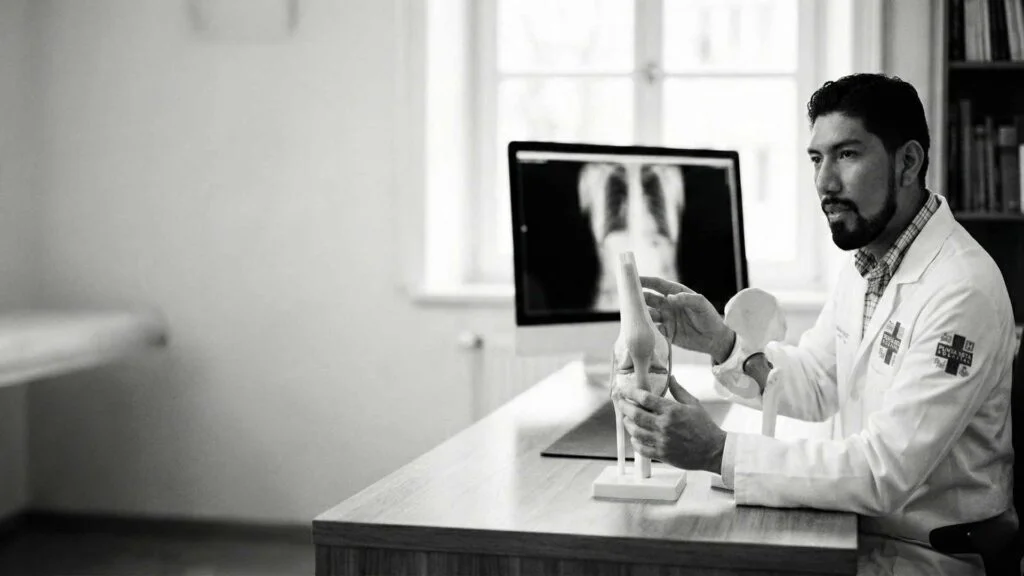
Shoulder replacement may be considered when pain, stiffness, or loss of function significantly limits sleep, dressing, personal care, or use of the arm. It is not recommended for every painful shoulder, and the decision is not made from imaging alone.
Patients from Riviera Nayarit and Bahía de Banderas are evaluated at Hospital Punta Mita.
When should you request an evaluation?
- Persistent pain that limits sleep or basic activities.
- Major loss of motion or strength.
- A previous diagnosis of advanced joint arthritis.
- Fracture sequelae or a complex injury.
- Major rotator cuff dysfunction with associated joint damage.
- Insufficient relief from applicable non-surgical options.
Not all shoulder pain comes from the joint
Joint
Glenohumeral arthritis may produce pain, stiffness, grinding, and progressive loss of motion.
Rotator cuff
Loss of strength and elevation may be related to tendons, with or without associated joint damage.
Fracture or sequelae
Anatomy, bone quality, and previous healing may change the treatment path.
What is reviewed before discussing replacement?
- Pain, stiffness, and limited activities.
- Active and passive motion.
- Rotator cuff strength and function.
- Stability, bone quality, fractures, and previous surgery.
- X-rays and available imaging.
- Previous treatments and functional goals.
- General health and ability to participate in rehabilitation.
Replacement configurations are not interchangeable
Anatomic
It may be considered when the joint is damaged and the rotator cuff retains suitable functional conditions.
Reverse
It changes shoulder mechanics and may be considered in specific situations such as major cuff dysfunction, complex fractures, or other conditions.
Partial
It is reserved for selected cases and is not automatically simpler or appropriate for everyone.
Availability and appropriateness are confirmed during evaluation and planning. No brand or configuration is presented as universally superior.
Arthroscopy and replacement solve different problems
Shoulder arthroscopy may treat selected internal injuries, but it does not substitute joint surfaces with advanced arthritis. The decision depends on cartilage, rotator cuff, bone, symptoms, and function.
Recovery by phases and goals
Progress may include initial protection, wound care, gradual motion, strengthening when appropriate, and progressive return to activities. The plan varies with the configuration, associated tissues, and baseline condition.
Universal dates for removing support, driving, working, or recovering a specific range of motion should not be promised.
Risks, cost, and logistics
Possible risks include infection, stiffness, instability or dislocation, fracture, nerve injury, wear, loosening, persistent pain, and additional surgery. Individual risk is discussed after evaluation.
A quote may include the hospital, implant, supplies, anesthesia, professional fees, tests, and rehabilitation. Insurance coverage depends on the policy and institutions involved.
Consultation takes place at Hospital Punta Mita. The surgical hospital and logistics are confirmed later. Patients from Riviera Nayarit, Bahía de Banderas, and Puerto Vallarta may use this location.
Related pages
Frequently asked questions
Does every painful arthritic shoulder need replacement?
No. The decision depends on the pain source, limitations, motion, strength, rotator cuff function, bone, imaging, and response to other options.
Are shoulder arthroscopy and shoulder replacement the same?
No. Arthroscopy treats selected internal injuries without replacing the joint. Replacement substitutes damaged surfaces in different clinical scenarios.
What is the difference between anatomic and reverse replacement?
Anatomic replacement generally requires favorable rotator cuff function. Reverse replacement changes shoulder mechanics and may be considered in specific situations. The indication is individualized.
Do I need an MRI or CT scan before consultation?
Not necessarily. Bring available studies. After examination, X-rays, MRI, or CT may be requested if they can change the decision.
How long does recovery take?
There is no universal timetable. It varies with the procedure, rotator cuff status, baseline function, required protection, and rehabilitation.
Where is the consultation performed?
The evaluation is performed at Hospital Punta Mita. The hospital and logistics for possible surgery are confirmed after assessment.